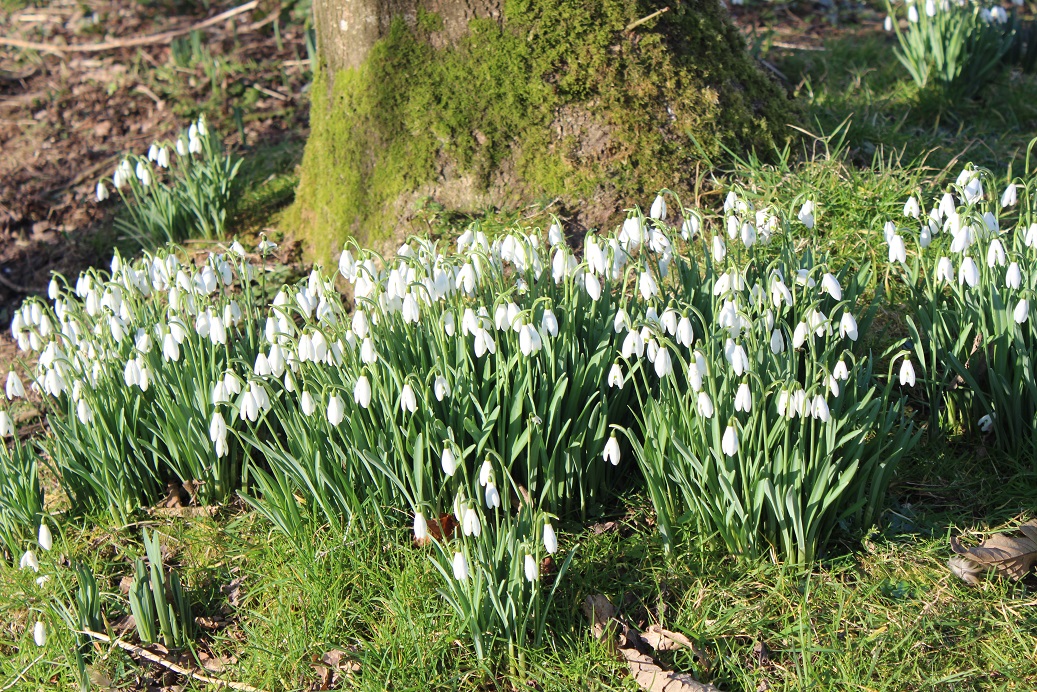
 The pressure to feature snowdrops at this time of year is extreme. Everywhere you look there are delicate white blooms with varying amounts of green and reflex. I have succumbed. The lure of these milky blooms is irresistible. They have earned their place here not just because they are harbingers of longer days and warmer feet. They have earned their place because they are charming and would be such at any time of the year. These flowers, nestled in the mossy base of a tree, are not expensive, nor rare, they are just minding their own business basking in the winter sun. Happy days indeed.
Puzzle
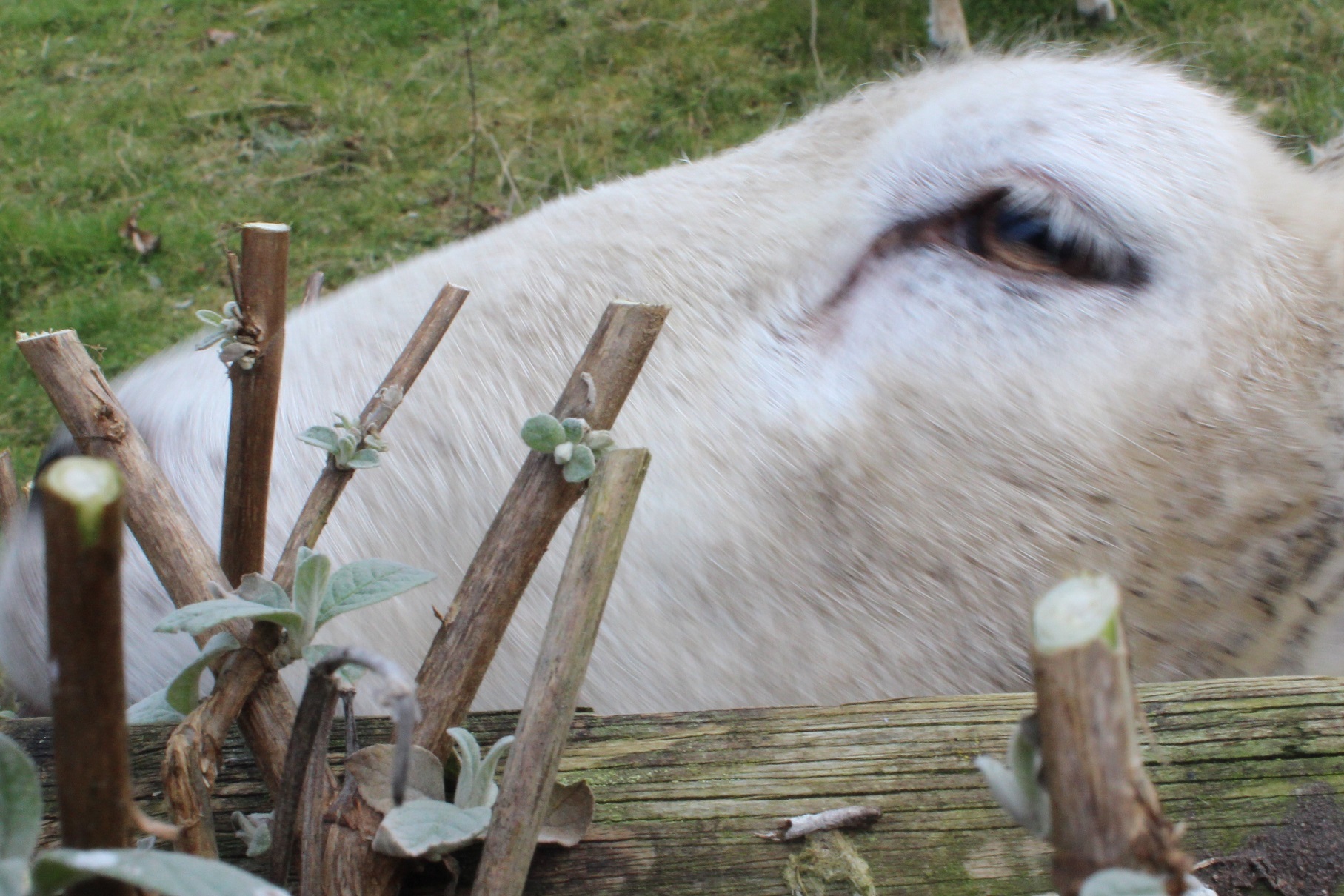 Today I have been trying to work out why this buddleja hedge has so many bald patches at the back, stripped of foliage and snapped in places. Perhaps it is a type of fungal die-back or particularly aggressive snails. If only there was some sort of clue. Seriously it is very tricky trying to prune (my excuse for the poor effort in this photo) whilst a far-too-fearless sheep is trying to do the same on the other side of the fence. On several occasions she nearly had a pierced nose!
Monsters
 There is good vegetable growing and there is showing off. The parsnip at the front is for the purposes of scale and is at this moment in time feeling very inadequate. Well done to the du Mauriers for producing these monsters. I did wonder if they were glowing green, just a little …..
Sophora microphylla – Kōwhai
 The golden droplet flower of the New Zealand kōwhai shone like a misplaced piece of summer at Chambercombe Manor at the weekend. Not thriving there, but managing to muster enough strength to pop out a few flowers on its scantily clothed boughs. Sometimes less really is more.
Tree Watching – A little waffle to fill the space
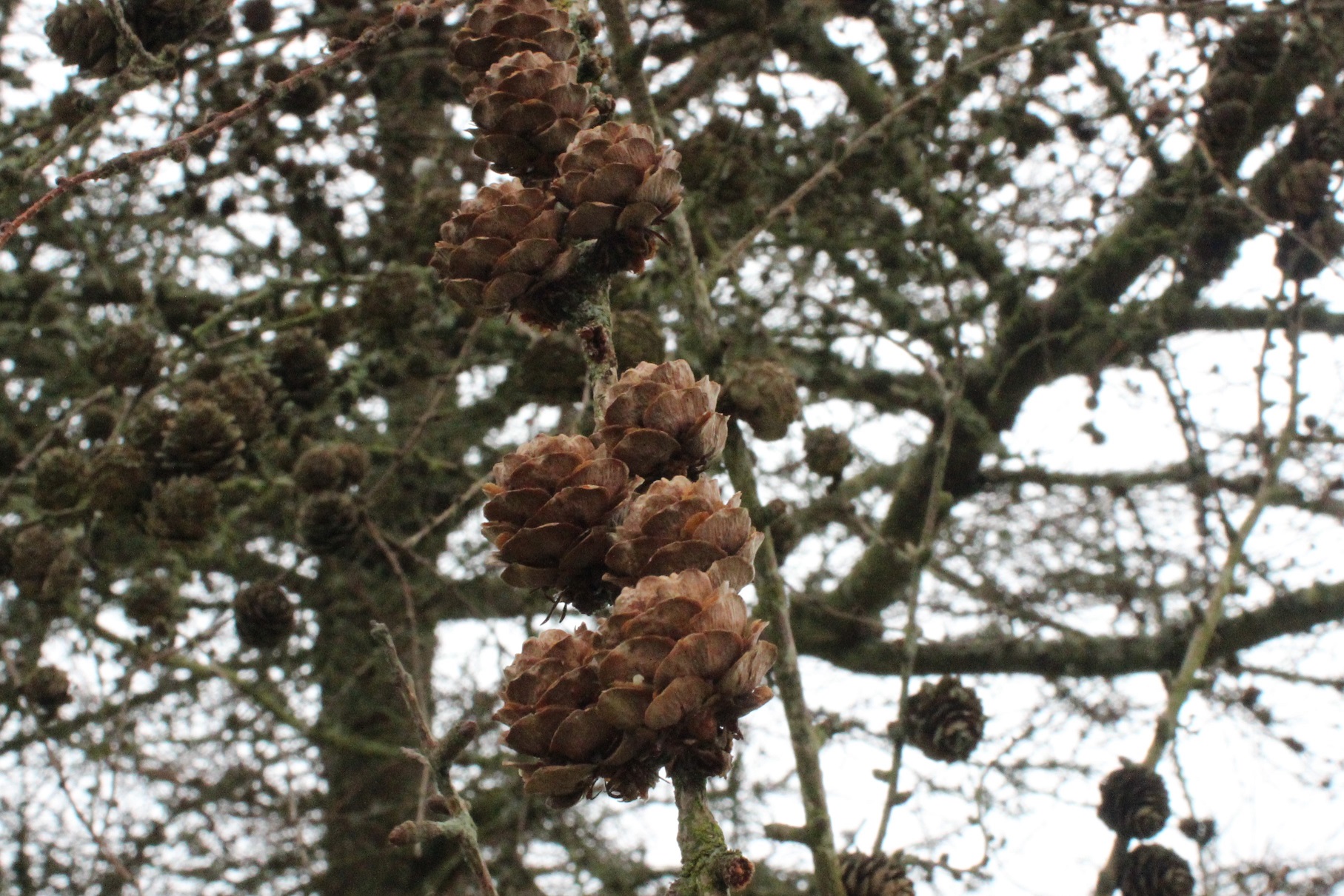 There is not a lot of action at the moment in Larchland. There may be a slight swelling of buds, but this is probably wishful thinking by Ms Eager Beaver. So I will use this lull in visible activity (I am sure there is a lot going on behind the scenes) to get you up to speed on Larix decidua. We wouldn’t want any embarrassing silences would we? It is a deciduous conifer, native to central Europe and introduced to Britain in the 17th century. It is a fast growing tree and the resulting timber is strong and resistant to rot, however the Japanese larch, Larix kaempferi, is considered superior and is more often grown as a plantation crop. “So how” you may well ask “do you know the difference between the Japanese and the European?”. Well apparently the seed scales on the cones bend downwards in the Japanese tree while the European’s curl upwards. As I have only just discovered this fact, I am very pleased that it appears I have identified this tree correctly, admittedly it was more luck than judgement. Unless, of course, I am deluding myself again and there is a little downward motion ….. no I must be strong in my convictions. These cones with their, undoubtedly up-curling, seed scales may remain on the branch for many years, so it is not even worth loitering just in case the deadlock may be broken by one falling off. Never mind, another month and it could be all steam ahead, otherwise brace yourselves for some more scintillating/sleep inducing facts!
NW5 – George
 As handsome as ever!
NW4 – Rejoice
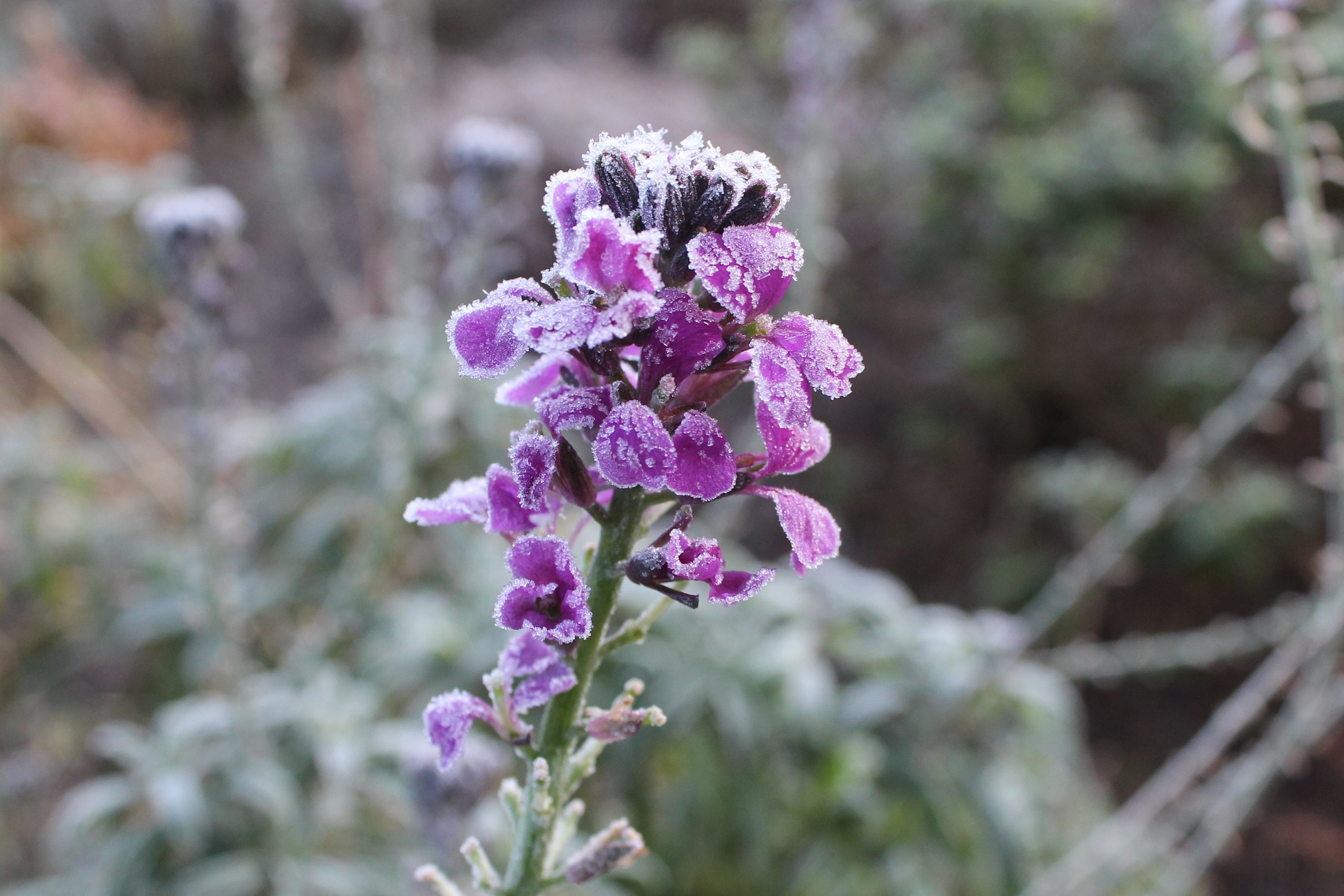 It is February now and the wheels are turning faster. The days are noticeably (and rejoicingly) growing longer meaning that not only is it easier to get out of bed in the morning but the plants are benefiting from more light. If I were a true plantophile these would be listed in a different order. Sometimes, however, a line has to be drawn.
NW Day 3 – Ophelia
 The hazy colours, frozen in time, brought to mind John Waterhouse’s painting Ophelia. Just before she got in, obviously.
NW Day 2 – Diamond Day
 Over the past few years I have had my battles with ivy, tugging and unravelling, prising their adventitious roots from tree, border and unsuspecting shrub. I have also admired and appreciated their many good points, listened to the throb of an insect blanket supping on their tardy flowers, watched as clumsy pigeons and flighty blackbirds feast on the deep dark fruit. Today was the first time that I marvelled at their beauty.
NW Day 1 – Puddle
 I didn’t promise anything about the posting of evocative photographs. Obviously I have no control over what you may or may not deduce from an innocent picture. This one seemed appropriate today, the reason why I am keeping to myself. You can interpret it entirely as you wish. It could indicate a leaky hosepipe, the discovery of an ancient spring, the creation of bog garden or something else that didn’t even cross my mind. Totally up to you ……
 Off The Edge Gardening