 Persicaria vaccinifolia is magnificent this week, dense and vibrant with its forest of pink tinged spikes. Will this season ever end? I think we can cope for a few more weeks.
Hygrocybe calyptriformis- Pink Waxcap
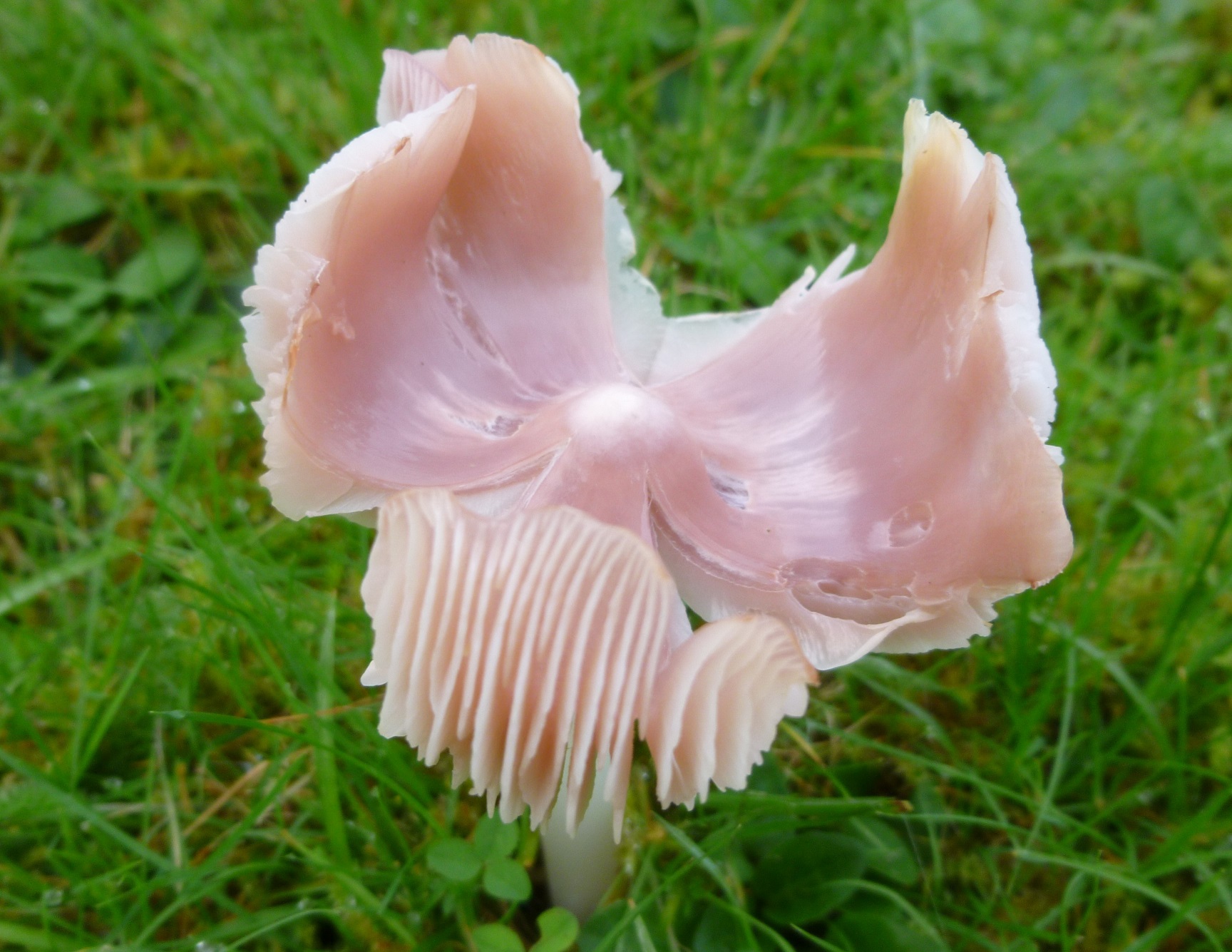 My knowledge of mushrooms is limited to fry ups and risottos. Apparently it has been a good year for the edibles but I am far too cowardly to pick my own. This combination of ignorance and cowardice has kept me alive so far. My poor fungal education does not prevent me from appreciating their beauty and today there were a fine assortment on the bottom lawn. These ranged from deepest red through additive orange and custard yellow to this palest pink waxcap. It is also known as The Ballerina and I am undecided as to whether it is a thing of beauty or would suit a supporting role in a horror film/sci fi movie.
I am hoping my identification is accurate, if any ballerinas out there are offended at my incorrect designation please forgive me and refer back to above “my knowledge of fungi is limited …”
Not Blue (For Adam D)
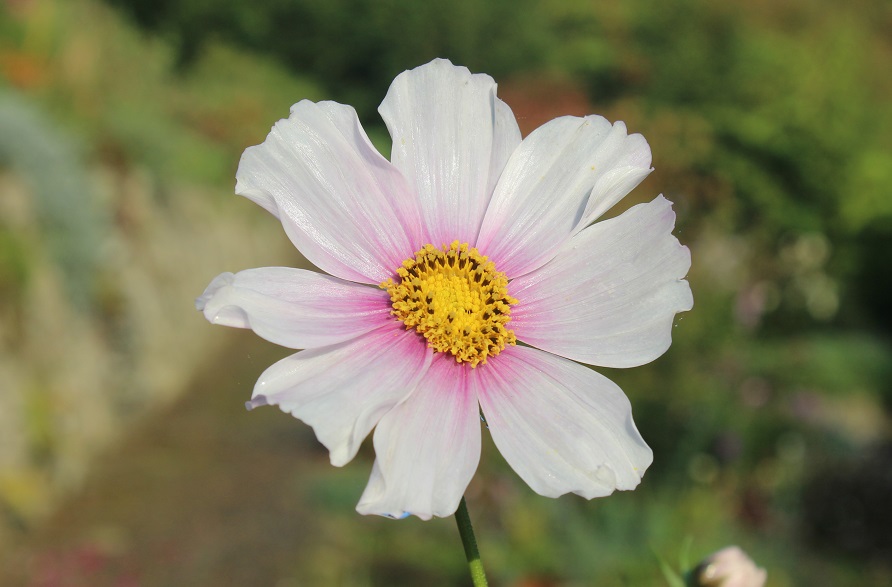 There is nothing in the slightest bit blue about this cosmos. In fact quite the opposite. Surely this perfect pink blushed bloom, with its central boss of saffron, would banish the deepest of blues to a place far far away.
Salvia uliginosa – Bog Sage
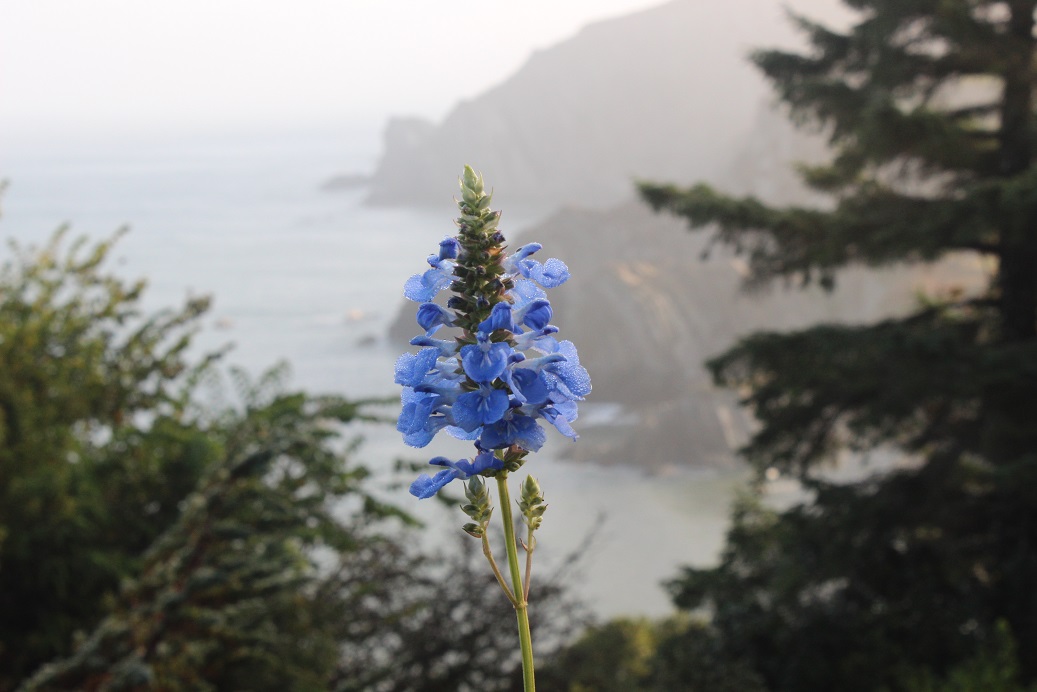 In the washed out misty morning this Salvia uliginosa looked like the focal point of a Victorian hand tinted landscape.
GP – Blue Hydrangea
 Let us talk about the fabled Blue Hydrangea, to some more desirable than the golden fleece, as sought after as the holy grail. Each year at the local flower show there is a category for Best Blue Mophead. This puzzles me. Actually a lot of what happens at the flower show puzzles me (although I love it really). Actually a lot puzzles me. Anyway let us not get distracted; my point is that the only requisite for growing blue hydrangeas as opposed to any other colour is that you must have acidic soil. Basically if you garden on alkaline soil you are stuffed. No matter how skilful a gardener you are you cannot avoid this fact. So to all those who say “I am desperate to grow blue hydrangeas but they always turn out pink” I would say, “Either move house or give up”. Don’t try to change the pH, don’t try to grow them in pots, don’t try witchcraft! You are fighting a fight in which you will always come second. This may sound a little defeatist, but some battles are worth the effort and some are not. By all means attempt to grow the Lesser Spotted Doddlewort from Outer Mongolia, take a crack at grafting a rose onto an apple tree, have a go at propagating the Amazonian Sky Fern, but do not try to grow blue hydrangeas if you have the wrong soil. Anyway what is so wrong with pink? Come on get in touch with your Barbie side!
I am not proud. I have no qualms about taking other people’s images and using them to my advantage. In a bare face manner. Not even blushing. A friend of a friend and now someone that I might just tag onto and pretend he is an old buddy took this picture. He is a real life photographer, he has won awards, he has photographed Ralph Fiennes for god’s sake! And he makes a mean curry (allegedly). Do not panic ladies and gents, I do have his kind permission to use this photo. Really you should check him out, his name is Matt Anker, he is the real McCoy. You can then also say that you almost know him.
Molly the Moocher
 It is a long story …..
ID
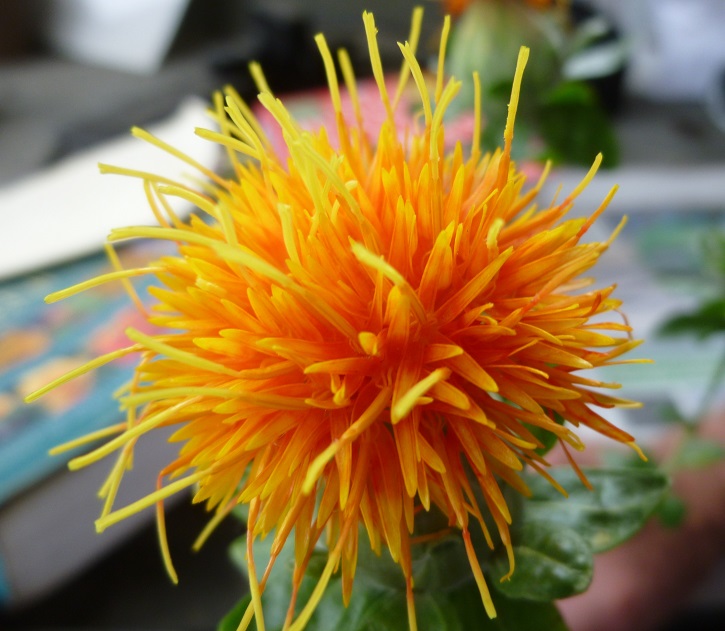 A request that puts fear in the soul of all but the most confident of gardeners is “can you identify this plant/flower/weed”. This is the horticultural equivalent to the doctor’s “I have a pain in my left kneecap”, the builder’s “there is a leak in our back bedroom” and the chef’s “my cake didn’t rise”. It happens frequently and of course I do my best but it is one thing recognising something insitu, quite another in the obscure states that are demanded. Sometimes it is a photo (the combination of a phone camera and me with no specs is a recipe for disappointment), sometimes a verbal description “blue, biggish”, occasionally a real life specimen, dessicated and crumpled, pulled out of a pocket or handbag. Today I was presented with the above flower, admittedly in fine fettle, which had come as part of a florist bouquet. I failed to ask if the gentleman in question had asked permission to raid his wife’s display, I would imagine not. Anyway I didn’t have a clue, what I did know was in this instance I was also eager to find what this splendid flower was. So I did what any “moderne” gardener would do in desperation, I Googled “orange thistle” and all was revealed. This is Carmanthus tinctorius, any the wiser? It is also known as False Saffron or Safflower, sounding a little more familiar? It is grown commercially across many parts of the world including the Americas, Asia and Australasia where the seed is used to make a vegetable oil very similar to sunflower oil. The petals are used as a substitute for saffron. There is evidence that it was used by the ancient Egyptians as a dye and is also used to colour Buddhist robes. It is also used as a nutritional supplement. So many virtues attached to one plant. This overt usefulness is all very well but let us not forget those stunning thistle like flowers which come in varieties of clear yellow, orange or red. The mystery is why haven’t I grown it yet?!
All you need is …..
 I think that pretty much sums it up!
Oasis
 As it turned out exact directions to Steve and Dawn Morgan’s house in Yelland were not necessary. There was nothing especially wrong with the other gardens in the neighbourhood, the usual mixed bag of tidy, not tidy, tidy but boring, tidy with promise, messy but interesting and then wham, did I just hop on the Malay Express?! Fragrant gingers and large-leaved paulownias screamed “this is not your usual North Devon front garden and wait until you see out the back, you are catching just a glimpse of the edge of my petticoat” or something like that anyway. As it was a Sunday morning and I was early (over eager after checking out their website http://www.devonsubtropicalgarden.co.uk) I decided to wait patiently until the allotted hour, it not being the done thing to catch your hosts in their onesies. I sat in the car practicing my deep breathing exercises trying to control the overwhelming urge to scale the gate and see what delights lay beyond. Luckily there was no need, which is just as well as these exercises have never worked in the past. I had been spotted and was invited in. Where do I begin? Hedychium on hedychium, colocasias with their sails of black, green and purple, passion flowers that remind you why their name is apt, brugmansias on steriods, the words alone are causing me to dribble (again). But the place that I kept returning to, the plants I stroked and lusted after more than any, were the bananas, more specifically the ensete, even more specifically Ensete ventricosum “Montbeliardii”, so beautiful I will even forgive it its unpronounceable name. My visit was an education, the Morgans were knowledgeable, generous and funny, I almost moved in. Actually, all you need to do is wrap me in a double layer of fleece and bring me the odd bacon butty and cup of tea and I will cuddle up with these fantastic plants all winter long.
Guest Photographer – Under Your Nose
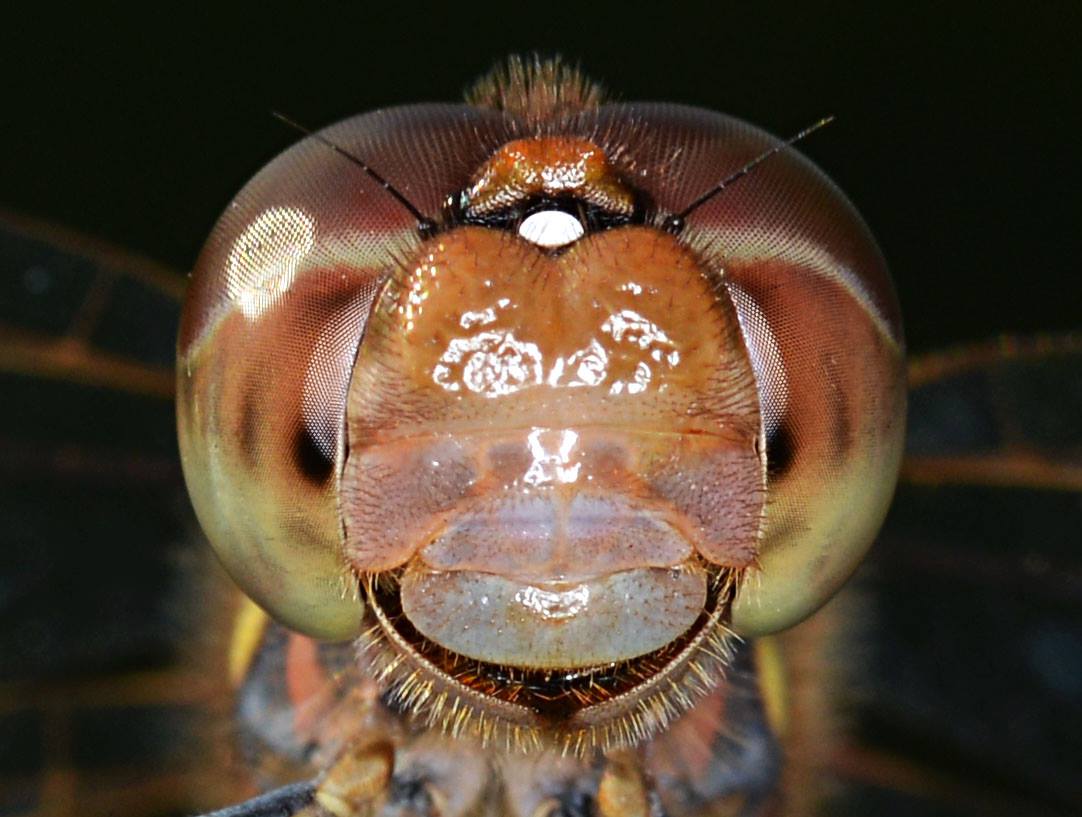 Nepotism is such a maligned word. The fact that these incredible photographs were taken by my brother is inconsequential. To capture these images he undertook a long and arduous journey off the settee, out of the back door and into his garden, I would imagine that a packed lunch was involved. And he hunts for creatures. And then he takes these wonderful shots.
Some are classically beautiful ….
 Some less so…..
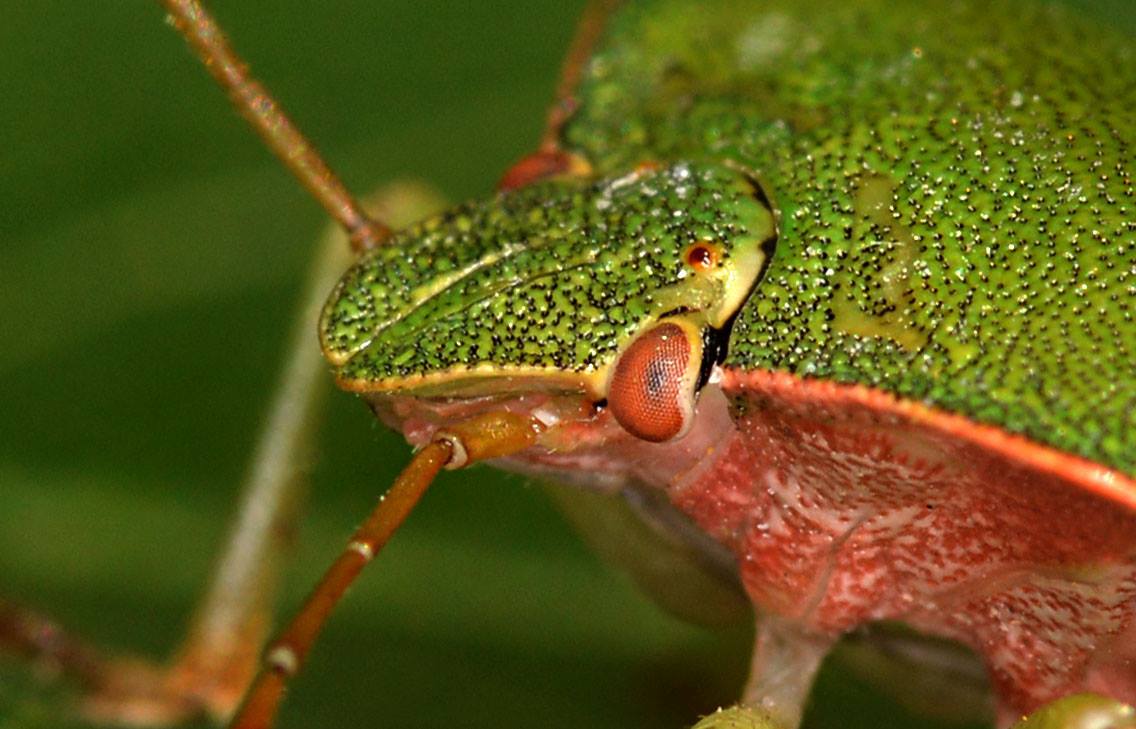 A few are on the macabre side …..
 With the odd cuddly critter ….
 The familiar……
 And the downright bizarre …
 All out there and many more, right under our noses. Each and everyone is part of the ecosystem, doing their jobs to keep things in balance. Most of us are unaware of their existence and more importantly pollute and destroy their habitats. We should perhaps take time to look a little closer when we go out into our gardens. It may give us a new perspective!
At the risk of being irritating, but after all what else is a sister for, I would just like to point out that I am starting a petition for a Under Your Nose blog. All those in favour say “Aye!”
 Off The Edge Gardening