Here in the south west of the UK we have pretty benign weather. It is for good reason that we are called Softy Southerns. The last couple of days have been a little crazy, in our opinion anyway. For others, more accustomed to such madness, it has possibly been a little dull. Hail, thunder and lightning, driving rain and strong winds. Our home faces the sea and whilst this is a generally a great asset, when the wind roars up the channel it is less charming. There is another, bigger, storm on the way, called Angus apparently. The winds will shift to the North-East and it is likely that we will have another window rattling night ahead. Today I have, perhaps a little latterly, brought in a couple of indoor plants that had been vacationing outside for the summer. The scadoxus and scented pelargonium were looking a little ruffled, outraged to have been exposed to such climes. I have no doubt they will recover from this horticultural abuse. The rest of the garden will have to fend for itself.
Stay safe everyone. Its going to be a noisy night.
Arid October has given way to soggy November. Mud skating has come back into fashion and everything is twice as tricky as it was a couple of weeks ago. Which means that tonight I am very tired. And it is only Wednesday.
I have got a new camera. Someone may have noticed. Perhaps not. This time I am going to look after it. No incidents with ponds or compost bins or tarmac. Honestly, I am going to try really hard to keep it safe. It has a brand new, pristine, case and it will live in my work bag. Admittedly these are less than Operating Theatre conditions, but marginally better than residing in my pocket alongside associated string, half eaten humbugs, tissues, labels, seeds and mud. This spotless camera will only be taken out when absolutely necessary. For example, when I want to take a photograph.
Linaria purpurea, the Purple Toadflax, shamelessly spreads itself about, popping up here, there and everywhere. In Lavinia’s Garden of Renegades it is very much at home. On Friday, a day blessed by both sun and warmth, a beautiful Red Admiral landed for perhaps his last feast before hibernation. By the time I had rummaged in my bag, found my camera amongst the cornucopia of very important stuff that lives there and returned, it had got bored of posing and flown to its next feeding station. So, I’m afraid you will have to use your imagination. Just squint up your eyes and place a hypothetical butterfly on the first flower. This may well be happening a lot.
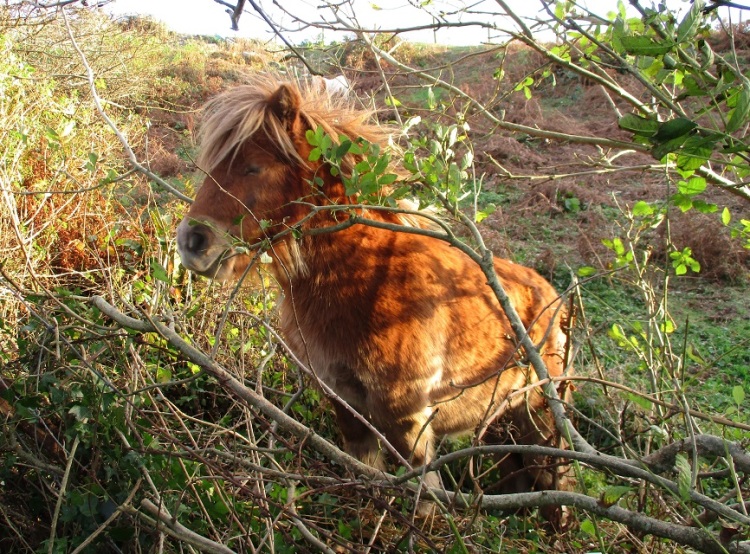
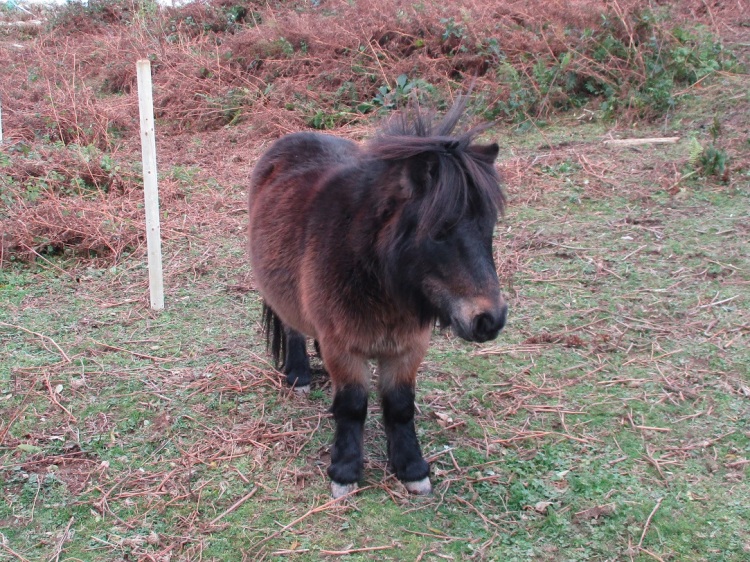
When I arrived at The Farm on Thursday Mr G told me that his first job of the day had been to corral two of the ponies back into their field. It was no surprise to discover that the Shetlands in question were the ring leaders of The Pony Posse; none other than Wild Tiny Hickok and his protege in demonry, Pippy “The Kid”. These reprobates are famous far and wide for their high jinx performed under the cloak of extreme cuteness.
Myself and Slasher found the gap in the hedge where they had escaped into the vegetable garden. SS blocked the gap and the Houdini’s were thwarted. For a while anyway.
The “must be achieved” task of the day was to set out the new orchard or, as Admin Annie has decided it is to be called, Norchard. Along with Junior we discussed layout, distance between trees, protection and timings. We then measured out optimum planting distances and positioned posts as centres for when the bare rooted trees arrive in the next few weeks. It had been decided that one of the crab apples that had been planted by some idiot (me) in a totally inappropriate place was to be moved to join those new Devon trees. Crab apples are great pollinators in orchards, so we chose a central spot and whilst slasher made a big hole, I dug up the mis-placed tree. Junior found temporary posts and chicken wire to protect the new resident from snacking animals. It was planted, watered in, mulched, job done. The first tree of Norchard was in place. A time for jubilation.
Except, I felt a little uneasy, something was not quite right. Big adorable eyes with oh so long eyelashes were watching us, our every move was being noted. We needed to be vigilant. This was no ordinary adversary. It called for extra-ordinary action.
Myself and Slasher got into our Dexter cow disguise, Junior into his kangaroo outfit, and we began our stake out in the adjacent field. The cow outfit work very well, in fact we had to spurn the advances of Bisley the Bull on several occasions. Sorry mate, already spoken for. Not quite so sure about Kanga though.
Pippy the Kid
It didn’t take long for Pip to sidle into position. His role was obvious, chief look out and get away galloper. He didn’t notice anything out of the ordinary, except perhaps a little bemused by the hopping cow.
When Pip had neighed the all clear, the suspect arrived on the scene.
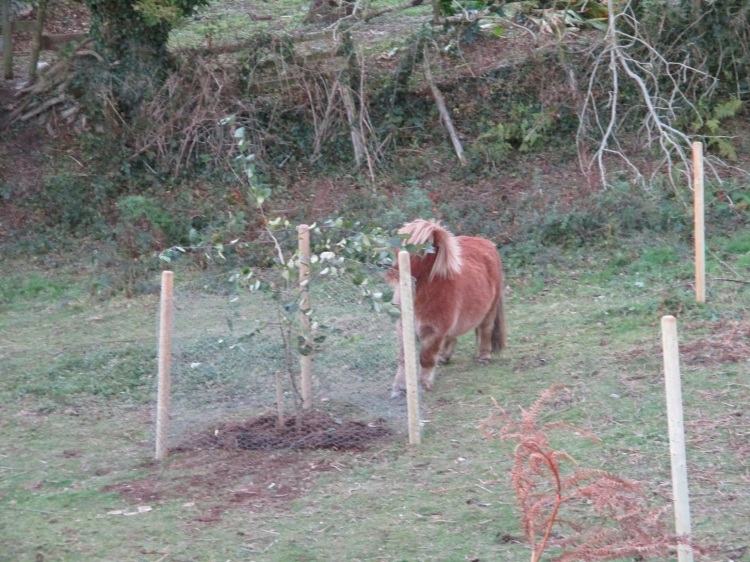
At first Slasher’s defence held out. Then the perp got luckily, the wind blew some of the longer crab apple stems over the wire and he grabbed hold of one and pulled. Then another, then another. Sorry for the fuzzy photo, I think Bisley was trying to make friends at this point.
When he finished the wayward shoots on that side, he took a wander to see what else he could steal. Circumnavigating the enclosure he then noticed some leaves poking through the wire and nibbled these too.
At this point I could take no more of the marauding hoodlum. We emerged from our hiding, rather shocking Bisley, and showed Tiny the photographic evidence we had of his crime. This would be shown to Mr G, who would be very angry. Everyone knows just how angry Mr G can get! At this threat he just tossed his golden mane in derision. He then blew a big raspberry at us and cantered up the slope with Pip by his side, whinnying with laughter all the way.
What hope have we against such a criminal mastermind?
The summer flower garden is like a large box of soft centres, so full of delights you aren’t sure which to enjoy first.
At this time of year it is quite different. Our blooms are increasingly akin to the Quality Street toffee that you find down the back of the sofa in a moment of great need.
This archaeological discovery is just as delicious and perhaps even more appreciated*. Maybe a little tatty at the edges, but definitely as sweet a treat.
* This does not mean that if you are thinking of buying me a present you should ever consider toffee. A big box of dark chocolates, thanks all the same.
In my world death has lingered close this week. More than one special friend has been touched by the great sorrow of loss. Although once-removed from these sadnesses, it has caused me to be rather more reflective than usual.
Today I drove a friend to North Devon Hospice to pick up his car, left there after the passing of his friend yesterday. This was my first visit to the hospice. Like many of these oases, where the compassionate help the vulnerable in their final days, I have heard nothing but fine things about the care provided here. But I had also heard wonderful things about their gardens.
As rain had decided to rest for ten minutes, I took it as a sign, and did not even attempt to resist the temptation to have a quick look.
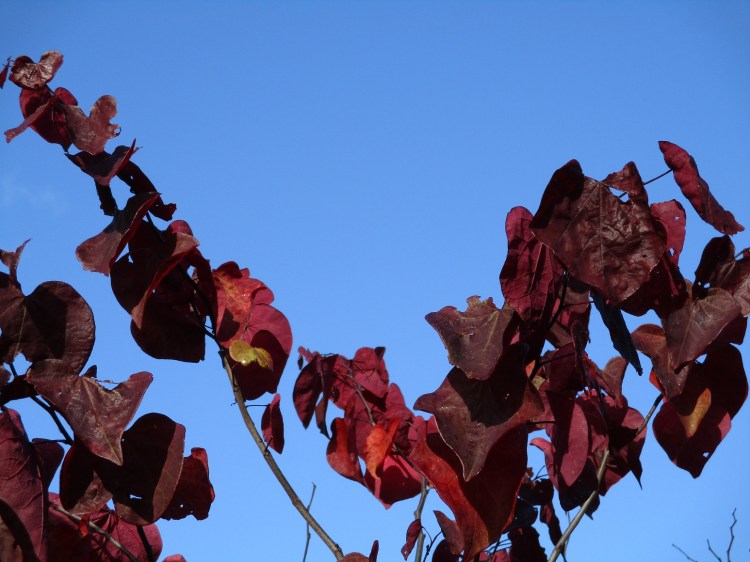
Cercis canadensis ‘Forest Pansy’
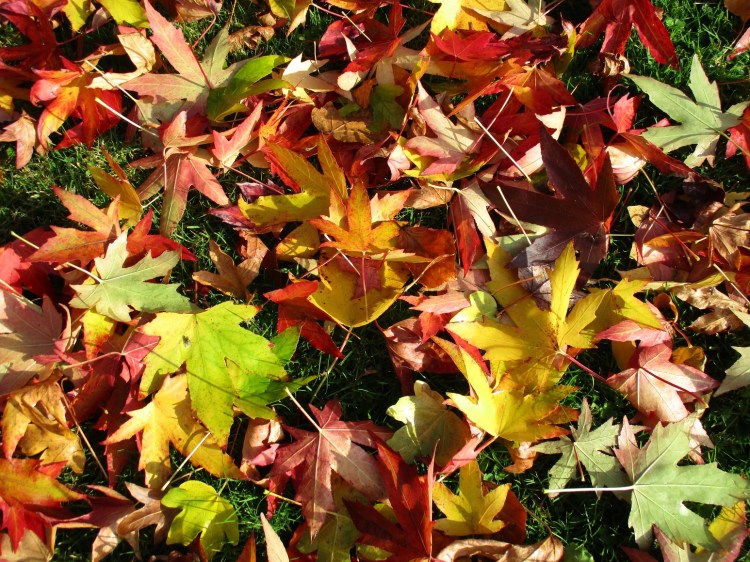
The autumn garden was, as you would imagine, looking its best. A large Cercis canadensis “Forest Pansy” looked stunning against the navy sky. After last night’s gales the leaves of Liquidambar styraciflua, the American sweet gum, carpeted the lawn. The cinnamon peeling bark of Acer griseum smouldered in the sun, with wheaten grasses and cyclamen providing a worthy under storey. In the reeded pond a swamp cypress, Taxodium distichum, with ginger needles, paddled in the shallows.
This was just an illicit taster, just a small section of the grounds. On three days each year they open these gardens to the public and I am determined to return to appreciate it fully. Us gardeners know all too well the beneficial effects of a garden. How much more can this be for those at crisis points in their lives? Healing, soothing, calming. Even a momentary escape from the harsh realities of life and death must repay a thousand fold. A beautiful distraction to allow the batteries to recharge, to strengthen, attune, accept.
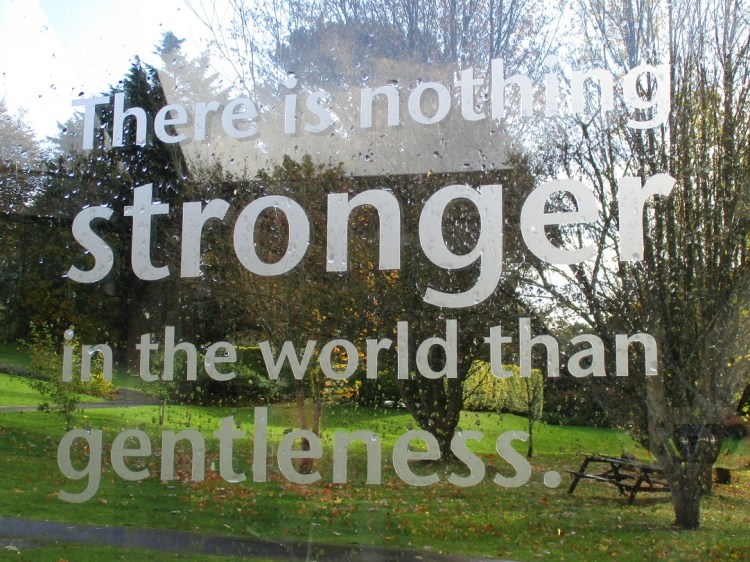
Before we left we came across a seating area, looking across the lawn to the trees beyond, protected from our fine North Devon weather by glass walls. This shelter was etched with sayings, both apt and uplifting. We walked around reading them out to each other. Like a soothing mantra. One in particular stuck in my mind. We could do worse than to remember this.
I have a large biscuit tin full of seeds, some collected, some gifted, some purchased.
I have little time for sowing, pricking out, potting on, tending.
So what did I do today? I ordered more seed. Twelve packets. Not only did I order more I ordered the unsuitable, the tender, the needy. The azure Willow gentian, Gentiana asclepiadea, the milk chocolate foxglove Digitalis parviflora, the red hotflame nasturtiumTropaeolum speciosum, the golden pea Lathyrus aureus, and an old friend, the cape wattle Paraserianthes lophantha. The words alone are pure poetry.
When the packs eventually arrive I will sit and carefully examine each in turn, imagining all the beauty that is contained within. I will praise them. I will flatter them. I will coo.
Then they will go in the tin, with the others, who no doubt diverge the sordid truth.
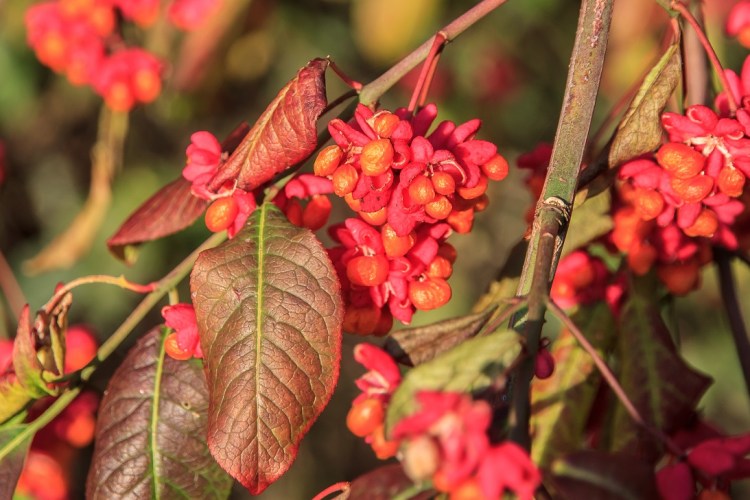
As I parked my Messerschmidt in the village car park, on route to Mr and Mrs Bun’s, my eye was caught by something gleaming bright in the corner. Squinting in a most attractive manner, I tried to fathom what this could possibly be. Drawn like an anvil to an industrial strength magnet, I wandered over to investigate the shining phenomena. Part hidden behind a large white van, I gasped as I spied the most wonderful spindle I had ever seen. The spindle, Euonymus europaeus, is a native British tree with an autumn display to rival any cultivated specimen. Cerise pink fruit open to reveal jaffa orange seed, a colour combination that warms my soul. The leaves turn burnished mahogany before they fall. I wondered how many others had spied this beauty and drooled.
As I have a tendency to over-share, I rushed to the Bakery demanding that The Buns come forthwith, at once, with all haste, to appreciate the glorious burning bush. They did and made all the right noises of appreciation. I don’t think they were humouring me. In fact I’m sure they weren’t. 80% sure anyway.
Mr B brought his camera with him. As you can see, Mr Bun is an accomplished photographer. A man of many talents.





 Off The Edge Gardening