Mystery

Cephalaria gigantea

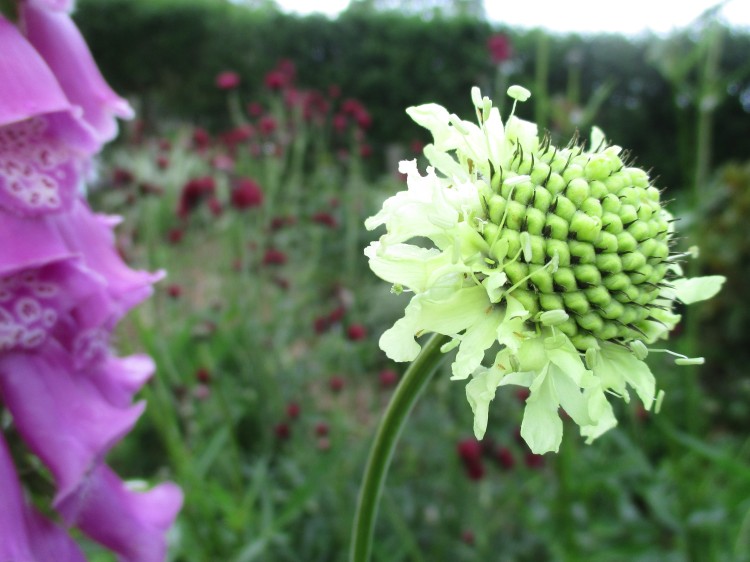
This is the first cephalaria flower of the year.  In Max’s garden anyway.  It is Cephalaria gigantea, the giant scabious, which when it gets into its stride will reach 2.5m in height and 1.5m across.  No need to inforce the Trades Description Act here.  It truly is a giant.  If you have a small garden you might be able to fit one in.   But nothing else.

At the end of last season Max’s Dad visited a very reputable establishment that begins with W and ends in Y and purchased some Cephalaria alpina.  Ringing the changes, so to speak.  This relatively diminutive cousin only gets to about 1.5m high.  The airy stems topped by pale yellow blooms would be perfect in the long border.

We chose a suitable mid to rear position for the new member of the family, introduced it to its new home, planted and watered.  Then we waited for it to grow.  And we waited.   And we waited. And eventually it grew to the heady heights of 20cm and started to produce flowers.  Pink flowers.

At this point, I carefully re-positioned to the front of the border and sighed.

On the plus side it is a pretty little scabious and is flowering beautifully.  What ever it might be!

Meadow Magic

Bee and clover

Mr Bun has been on a mission.  It has been rather scary at times.  Perhaps the first words he ever said to me were “do you know about meadows?”.  Um, a little, definitely not enough for your purposes.

This has not deterred him.  A gentleman who is in his second prime of life, who has recently climbed far enough up Everest (yes that gurt big mountain) to put the rest of us mere mortals to shame, is not going to let much phase him.  So he has been a’meadow making.  He has researched, questioned, prepared, stared at earth, doubted a little and is now semi-rejoicing.

This week the difference in his patch is phenomenal.  And it is a patch.  No more than 3m x 2m. We stood and admired it’s good behaviour before setting off to work.  Myself and Mrs Bun tended borders and beds, planting, weeding and chatting, the usual. Bees were supping and a gentle hum of insect pervaded even though the day was murky.

Just before home time, Mr Bun appeared with a list of the wildflowers he had sown and we trekked down the garden to do some tentative identification.  I spotted bird’s foot trefoil. Several times.  Different versions, obviously.  There was citrus sorrel and common knapweed and purple vetch and ox-eye daisies and a selection of grasses that begged closer inspection.  However, what was almost shocking was the preponderance of insect life.  The main garden was apparently merely a waiting room for the main party.  I reached for my camera and in the excitement pushed all the buttons in one go.  Inadvertently I set it to Night Mode.  I didn’t even know there was such a thing.  This means there were no photos.  A lesson learnt.  Perhaps.

Mr Bun is also an accomplished photographer.  Yes, he is very annoying.  This is one of his wonderful pictures which he has kindly loaned me.  I have to give it back later.

Here we have a bee (perhaps a tree bumblebee Bombus hypnorum) dining on red clover nectar, Trifolium pratense.  But it was not just bees, all kinds of flying folk were here, wasps and hover flies and the like.   Who knows what lay beneath the sward?! The rest of the garden paled into invertebrate insignificance.  And all in an area 3m x 2m.  Each and everyone of these creatures will benefit not only this garden but those around it by helping to maintain an ecological balance.

Really there is no excuse.

Well done Mr Bun.  What next?

Fur and Flowers

Stachys byzantina

I work in Mr and Mrs Bun’s garden once every three weeks or an approximation of that.  This means that a lot changes between visits and at certain times of year these differences are more extreme.  Like this time of the year.  Today fragrant roses had replaced tulips, forget-me-nots were mere memories, clematis flowers like saucers were peeping out of shrubs and the lemon verbena had fully recovered from its winter sulk, sharing its sherbet scent as it was brushed past.  The new meadow was a full foot taller, dahlias were just beginning their show, hollyhocks were pushing skyward and scabious cushions supported industrious bees.  All was doing what it was supposed to be doing.  Well most of it anyway.

This Stachys byzantina has grown too large for its position and is scheduled to be moved at some time in the future.  Until then, and its inevitable cut back, we can enjoy both fur and flowers.

We’ve Got the Power

Calendula Power Daisy Sunny

If there was a flower that summed up this glorious day it would be the Power Daisy.

I must admit that when Mrs G spotted this in a plant catalogue, although new to me and for no reason other than snobbery, I tried to steer her away.  “I think there is something really good on the next page” trying to divert her attention to something more worthy “did I see something about free Monster Munches with every purchase?”.  What I was thinking was “What kind of name is Power Daisy? Sounds like another gimmick to me.  A trap for the horticultural vulnerable”.  Of course as it was Mrs G’s party she was free to Power Daisy if she wanted to.  And she did.

And it transpires that I was quite wrong.  Well I was right about the naff name, but not about the plant.  From small beginnings last year they grew strongly, giving a fine display until late autumn. Not only have they all successfully over-wintered, they began flowering over a month ago and look likely to continue that way.  They have had no special treatment.  Just my usual love and the odd tune.

It is a calendula hybrid.  This one is called Sunny and never has a plant been more accurately named.  There is more on their story here in Mr Fothergill’s Blog.  Apparently more colours are on the way.  Bring it on!


Paeonia x lemoinei ‘Souvenir de Maxime Cornu’

Paeonia x lemoinei 'Souvenir de Maxime Cornu'

I’m still reliving last week’s Plant Heritage Road Trip.  If you like you can come along too.  Jump off now if you’ve got better things to do.  Just don’t tell me, I will be hurt.

Now we have arrived at the Bishop’s Palace Garden in Wells.  It is still raining.  Waterproofs are being challenged.  There may be seepage.   We are all being very brave.  And dripping quite a lot.

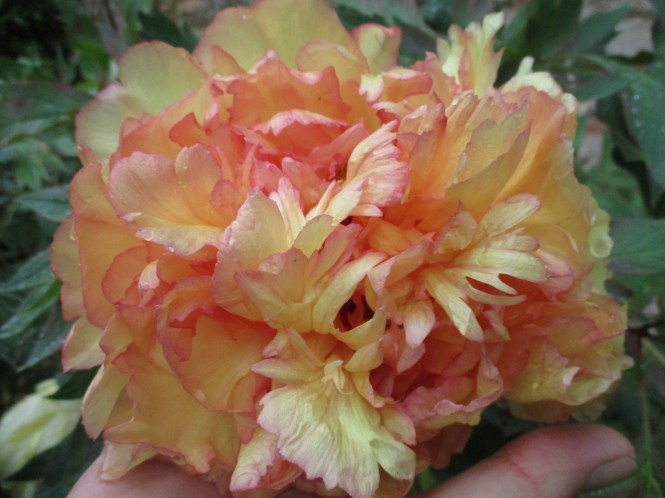
Unlike our motley crew,  a little precipitation could not sully the beauty of this tree peony.  Its name, Paeonia x lemoineiSouvenir de Maxime Cornu‘, as extravagent as the bloom.  Her head hung low, unable to endure a combination of excesses; a myriad of petals, a torrent of rain.  When a friend lifted the flower for my inspection I doubted there would be a scent, but there it was, delicate and fruity.

The sun shone for a moment.

Got there in the end

Asclepias curassavica, Bloodflower

For those of you who doubt that I am a proper grown up gardener, I must confess that once upon a time I actually did some training.  And it was in horticulture.  Of all things. Crazy I know.  And the esteemed hub of learning that had the pleasure of my patronage was none other than the world renowned Cannington College in Somerset.  Perhaps just “Cannington” at the moment, but working towards greater things.

Now the story gets a little complicated.  Although it was officially “Cannington College” I was actually based in a satellite division in Bristol, my time spent between Bristol Zoological Gardens (the clue is in the name) and in a defunct walled garden at Blaise Castle.  The only time we actually went to Cannington was for the Unit called, which I think has certain industrial chic, “Machinery”. From my slightly dodgy memory, this involved driving tractors, laughing and maintaining lawnmowers.

At this time I was still working in an office whilst studying part time.  My employers generously paid for us “gals” to go for a day at Champneys Health Spa.    Included was a “healthy” lunch, full use of the gym, pool, hot tubs, a manicure and massage. With great foresight we had stocked the minibus full of wine and crisps for the return journey. The following day, when my colleagues had returned to the photocopier and filing cabinet, I was adjusting the blades on a Qualcast.  In perfect purple nail varnish. Not sure my tutor understood the irony.

During the two years that I was a Cannington student, we were never invited to the walled garden. When it was demanded that we continue our quest to achieve the perfect cut, we once again headed west.  Our minibus, driven by the wondrous and fearless Julie, arriving in the village turned utilitarian right, whilst the joys of the famous garden lay to the decorative left.  Never did the twain meet.  Were they trying to tell us something? Perhaps.

So when my local Plant Heritage group arranged a trip to this garden, it seemed that it was an opportunity for what Oprah would call “closure”.

What had I missed?  Some beauties actually.

There was a full flowered Cornus controversa ‘Variegata’.

Wedding Cake Tree, Cornus controversa 'Variegata'

A Judas tree, Cercis siliquastrum, dripping both bloody blossom

Cercis siliquastrum, Judas Tree

and seed pods.

Judas Tree, Cercis siliquastrum

The outlandishly exotic Beschorneria yuccoides

Beschorneria yuccoides

Dew dropped poppies

Poppy

And weeping Iris

Iris

And much, much more.

I did skulk slightly, worried that I would be discovered and sent back to sharpen a blade or reverse a trailer into a gateway.  Old habits never ever die.